The Invisible Culprit Behind Edge Banding Adhesion Problems in Winter: Cheap EVA Adhesives
Adhesion problems with edge banding during winter months are often initially blamed on the edge banding itself. Complaints like "didn't hold in the cold," "opened up after pressing," or "swelling and delamination after shipping" are frequently encountered on the shop floor. Yet the reality we see in practice is quite different: The same edge banding, with different adhesive usage, can perform perfectly on the same line one day and be problematic the next.
In this article, we focus specifically on EVA (hot melt glue) and PUR (reactive polyurethane) adhesives and their differences, but more importantly on how "cheap EVA adhesive" creates serious risks in winter months.
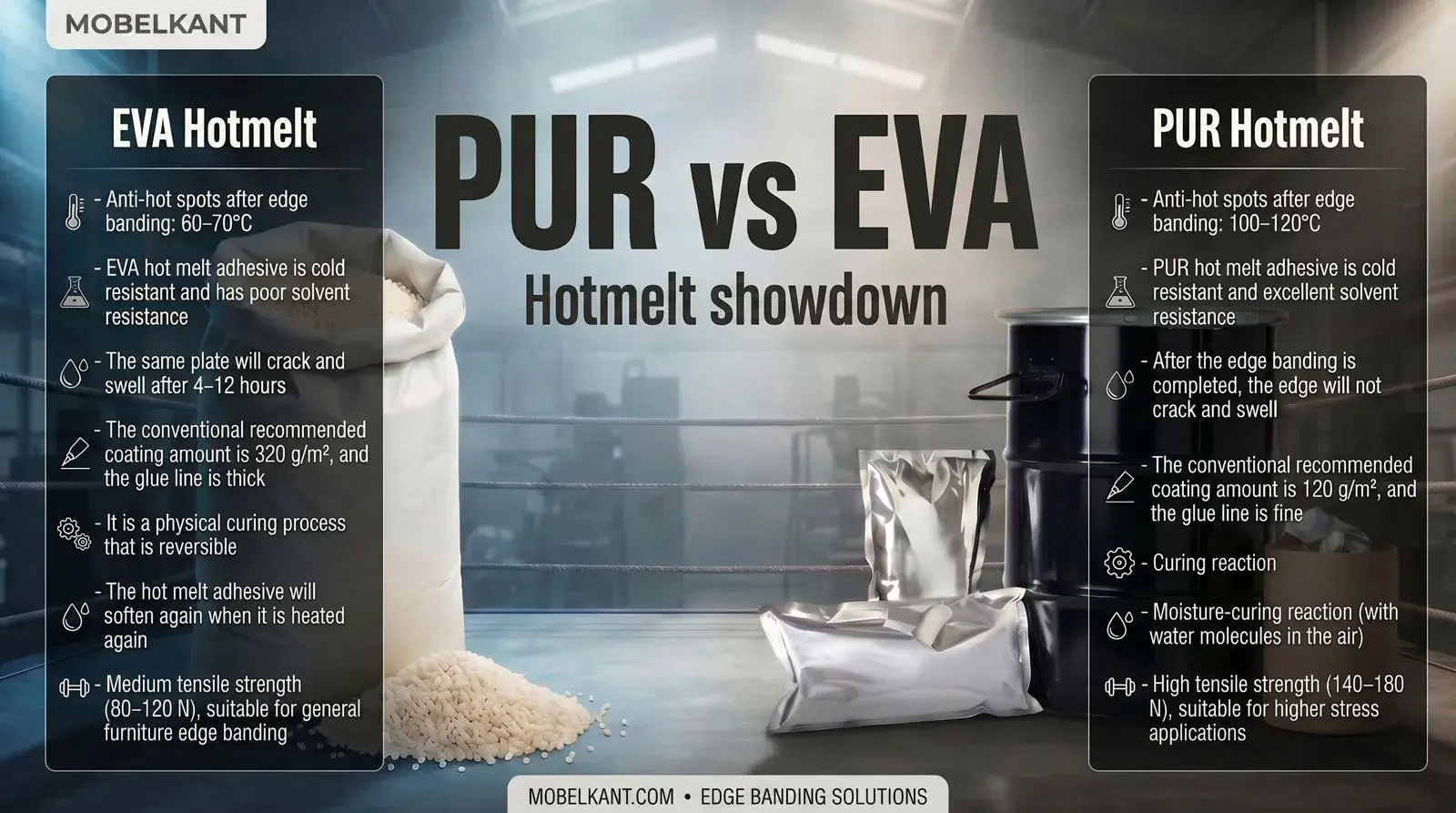
EVA vs PUR: Not Just a Chemistry Difference, But Also Risk Management
In furniture edge banding lines, we work with two main families on the hot melt adhesive side: EVA and PUR.
While this difference may seem technical on paper, it translates to the following results in the field:
- ▸PUR provides much more stable bonding performance in challenging conditions such as low temperatures, humidity changes, transportation, and storage.
- ▸EVA does not cause problems with the right formula and application temperature, but its sensitivities are much higher than PUR's; especially in products where the formula has been cheapened.
The Race to Over-Fill EVA: Is Cheap Adhesive Really Economical?
Today there is such intense price competition in the EVA adhesive market that the filler content in many products has reached up to 60%. This means:
- ▸Less actual polymer in the formula, more cheap mineral filler.
- ▸Even though it appears to "flow, spread, and bond" on paper, the actual bond strength weakens.
- ▸Resistance to temperature changes, impact, moisture, and the time factor drops significantly.
That's why we now hear about products called "summer adhesive" and "winter adhesive" in the market. This is actually an admission of the problem: Some EVA adhesives sold as "summer adhesive" are not even guaranteed by the manufacturer for winter conditions due to their excessive filler content.
The critical point here is this. This seemingly cheap EVA adhesive is actually not economical in two ways:
- ▸Per-meter consumption increases. Because filled, weak adhesive contains less binder, operators unknowingly apply more grams. As a result, the product with a cheap kilogram price becomes expensive on a per-meter cost basis.
- ▸The risk of bonding problems increases geometrically. When filler is high, binder is low, and the weather is cold, band delamination, swelling, and cracking become much more likely. These products create quality complaints and return risks while expecting economic advantages.
Why Do We See These Complaints Much Less with PUR?
PUR adhesives are inherently reactive and chemically curing systems. When proper preheating and process parameters are provided:
- ▸Even at lower film thicknesses, they provide high bond strength.
- ▸They are much more tolerant of extreme conditions in cold, heat-cold cycles, and humidity changes.
- ▸In high gloss, lacquered, postforming, and high heat/moisture contact applications, they provide a clear safety margin compared to EVA.
Same band, same panel, same line… While the complaint rate rises significantly in EVA production with cheap/over-filled adhesives, bonding problems seen during the same periods decrease significantly on PUR lines.
The Hidden Cost of Cheap EVA: Excess Consumption + Excess Risk
Cheap EVA adhesive doesn't mean "I'm just accepting the risk"; it actually means you're spending more money.
- ▸Per-meter cost: With higher quality EVA or PUR, you get more meters with a thinner film, while with cheap adhesive you get fewer meters with a thicker film. The product with a higher kilogram price becomes more economical on a per-meter basis.
- ▸Quality complaints / returns / rework: Every product with a bonding problem generates chain costs such as rework, waste, customer complaints, and reshipping. It damages both quality perception and increases total cost.
Our Recommendation for Winter: Protect Your Edge Banding with the Right Adhesive
At Mobelkant, we always look at edge banding performance as a whole: band + adhesive + machine + environmental conditions. We see a common point in most winter complaints: the filler ratio of EVA adhesive is too high, the "summer" formula is being used in cold weather, and attempts are made to "manage the situation" by increasing the application weight.
If the manufacturer doesn't even guarantee it for winter, you are loading unnecessary risk onto your products and brand.
Don't just look at the kilogram price. You'll often find that the product you thought was "expensive" is actually more economical.
For high gloss, white/light-colored products, long shipping distances, and projects stressed under storage conditions, PUR hot melt adhesives provide a significant safety margin in winter months.
Most of the time, the problem is not the band but adhesive selection and application conditions.
Conclusion: Quality in Edge Banding Starts with the Right Adhesive
A significant portion of the adhesion problems experienced with edge banding in winter months is related not to the band but to EVA adhesive formula and consumption habits.
- ▸Over-filled "summer" EVA adhesives may seem cheap in the short term;
- ▸However, they mean higher consumption, higher complaint risk, and a more expensive total cost.
PUR adhesives and well-balanced, quality-formulated EVAs, when chosen correctly, offer both more economical per-meter costs and, especially in winter conditions, a much safer solution.